i. Preserve
A living line,held in two cities.
A cell line is a living copy of your animal's genome, kept in culture, tested, and frozen so that nothing about it changes. It is the only step every other service depends on.
Day 0
Biopsy
a few minutes, local anaesthetic
Day 3
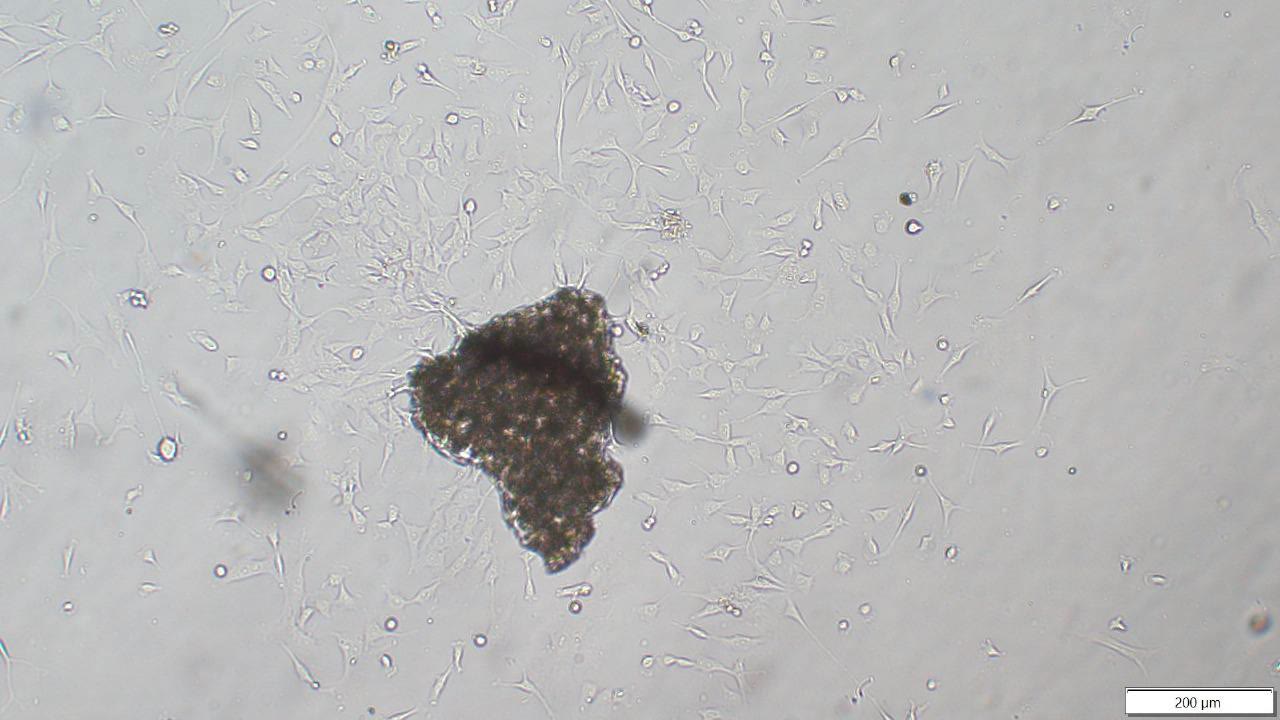
First fibroblasts
cells leave the tissue edge
Day 14
Confluent
the flask is covered
Day 21
Tested and banked
−196 °C, two cities
i.
What a cell line is
We take a skin biopsy the size of a grain of rice under local anaesthetic, in a partner clinic or at your home. In the laboratory the tissue is placed in culture medium; within days fibroblasts – the cells that build skin – grow out of the tissue edge and multiply. After two to three weeks they are counted, checked for viability, tested for mycoplasma and confirmed against the animal's own DNA. Then they are divided into vials and cooled to −196 °C in liquid-nitrogen vapour, where cell metabolism stops. Frozen this way, cells remain viable for decades.¹
- Biopsy
- A 4–6 mm skin sample, healed in days.
- Fibroblast
- The skin-building cell we culture.
- Passage
- One round of cell division in culture; we bank at passage 2–3.
- Viability
- The share of cells alive after thaw, tested on a sample vial.
- Mycoplasma
- A contaminant we screen every line for.
- Cryovial
- 1 ml tube; each line yields 8–12.
- Mirror
- Vials split between two of our laboratories.
ii.
What you receive
Preservation is not a promise on paper. Before a line enters the vault it has been photographed, counted and signed, and every one of those records is yours. The same documents let any qualified laboratory – ours or another – pick the line up years from now and know exactly what it is holding.
- Growth record
- Dated micrographs and cell counts from biopsy to banking, signed by the scientist who grew the line.
- Vault certificate
- Registry number, species, date of deposit and both cities holding the line. Engraved and issued once.
- Registry entry
- A plate in the registry with the line's sigil – a glyph drawn from its own genome hash.
- Vault address
- Laboratory, rack, box and position of every vial, in both cities.
- Annual storage report
- Once a year: tank temperatures, audit results and the current location of every vial.
iii.
Limits first
A banked line is…
- A living copy of the genome
- A starting point for cloning, testing or therapy
- Yours, and transferable
A banked line is not…
- A guarantee that cloning will succeed
- A copy of memories or character
- A substitute for veterinary care
About one sample in twenty grows too slowly or not at all – usually because the tissue was small, dry or old. When that happens we say so within three weeks and, where the animal is alive, take a second biopsy at no charge. Read how the same process runs after death on Urgent.
iv.
Prices
- Cell banking, UAE
- $5,000 – biopsy, culture, testing, banking in two laboratories, first year of storage.
- Cell banking, GCC
- $6,500 – the same, with collection in Bahrain, Qatar, Saudi Arabia, Oman or Kuwait.
- Cryostorage
- $500 a year, from the second year.
- Shipping between laboratories
- Included.
v.
Questions
- Can cells be banked after my animal has died?
- Often yes, within the first day or two, if the body is kept cool and not frozen. Call us first – before anything else is arranged. The first-hours guide explains what to do.
- How long do cells last at −196 °C?
- Decades. Frozen cells do not age: at this temperature their metabolism has stopped. Lines stored since the 1970s have been thawed and grown.
- What if I move country?
- The line stays where it is and remains yours. At your request it can be shipped to another qualified laboratory in a dry vapour shipper, with the permits prepared for you.
- Who owns the cells?
- You do. Reem Bio is custodian, not owner. The clauses are set out on Trust and custody.
- Can I withdraw?
- At any time, in writing. We destroy every vial at both sites and confirm it in writing. No reason is needed.
- Do you test for disease?
- We test the line for mycoplasma and confirm identity against your animal's DNA. We do not diagnose your animal; genetic screening is a separate service described on Know.
- How many vials?
- 8–12, split across two laboratories. More can be grown from the same line later if needed.
- Is the biopsy painful?
- It is done under local anaesthetic and takes a few minutes. The site is closed with one or two stitches or tissue glue, and most animals are back to normal the same day.
- Does banking commit me to cloning?
- No. Preservation is complete in itself. Testing, therapy or continuity can follow years later – or never.
vi.
Begin
Preservation starts with one conversation.
Book a consultation