How long dofrozen cells last?
It is the first question almost every owner asks, and the honest answer is that no one has watched a vial for a century. Here is what the evidence supports, and what it does not.
Reem Bio Laboratory ·
i.
A question with an honest limit
Cryopreservation as a routine laboratory practice dates to the 1950s and 1960s, when researchers first worked out how to cool cells without shredding them with ice. That means the oldest continuously stored cell lines in the world are now on the order of sixty to seventy years old, and many of them, when thawed, still divide. This is real, published evidence. It is also, by definition, the longest anyone has ever had the chance to look. No laboratory can hand you a certificate for a hundred years of storage, because no vial has existed that long yet.
So the honest position is this: cells held at deep cryogenic temperature have been recovered, viable, after several decades, and there is no known biological mechanism by which they would fail after that point simply because more time passed. The limiting factor, as far as anyone has established, is not the cell's internal clock. It is the storage itself – whether the temperature was actually maintained, and whether the freezing was done well in the first place.
ii.
Why cold this deep stops the clock
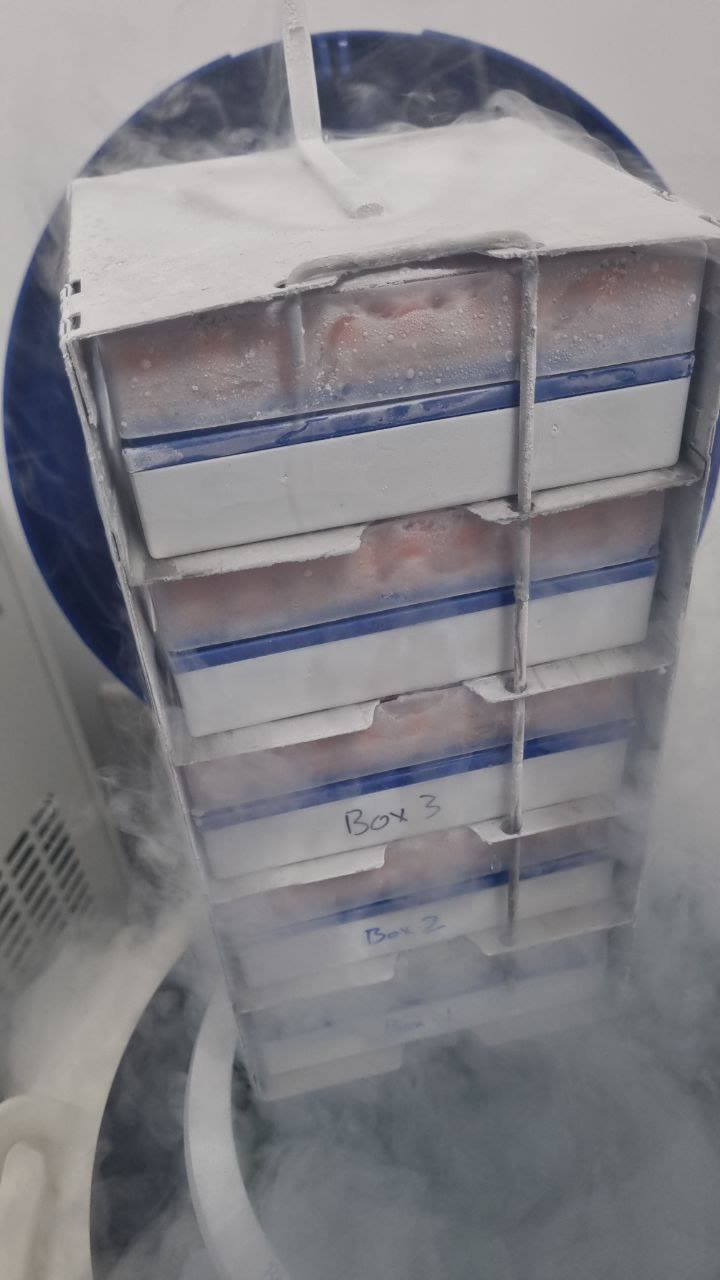
Ageing, in the sense that matters to a cell, is chemistry: enzymes catalysing reactions, molecules diffusing and bumping into each other, gradual accumulation of damage that the cell's repair systems only partly keep up with. Chemistry needs molecular movement, and molecular movement needs thermal energy. At −196 °C, the temperature of liquid nitrogen, that movement is reduced to something close to a standstill. Water is locked into a glassy, non-crystalline state rather than the crystal lattice that would otherwise tear membranes apart¹
This is why cryopreserved cells are sometimes described, loosely, as being in suspended animation. It is a fair description of the intent, though we avoid the phrase in our own materials because it invites more than it delivers. Nothing about a frozen vial promises what will happen when it is thawed years later; it promises only that very little should have changed while it waited.
iii.
What actually causes failure
When a stored line turns out to be unusable, the cause is almost never age. In our experience, and in the wider literature, failures trace back to a handful of practical points: cells frozen at too high a passage number, after they had already used up much of their capacity to divide; a cooling rate that was too fast or too slow, so ice damaged the cells before the cryoprotectant could do its work; a temperature excursion during storage or transport, where a vial warmed enough for ice to reform even briefly; or simple record-keeping failure, where a vial exists but no one can say with confidence which animal it came from.
What a storage discipline controls for
- Passage number
- Frozen at passage two or three, while cells retain the most division capacity
- Cooling rate
- Controlled at roughly 1 °C per minute down to −80 °C before nitrogen storage
- Temperature record
- Continuous monitoring of dewars; an excursion is a recorded event, not a guess
- Chain of custody
- Every vial tied to a tested DNA identity profile, not only a label
None of this is exotic. It is closer to careful bookkeeping than to advanced biology. But it is the part of preservation that a laboratory controls, and it is the part that matters far more than any number of years.
iv.
Why we bank twelve vials, not one
It helps to compare this with a different, related question owners sometimes ask: how long does the storage facility itself need to last? The answer is that it does not need to be the same building for sixty years. What must persist is the temperature and the chain of custody, not any particular physical structure. A facility can be renovated, expanded, or even relocated, as long as every transfer is done under controlled conditions and documented, so that the identity and storage history of each vial remains unbroken. This is one more reason record-keeping sits alongside temperature as the two things that genuinely determine how long a line remains useful.
Each deposit with Reem Bio yields twelve vials, split so that six are held in the primary vault and six in a mirrored vault in a second city, at the same −196 °C. This has nothing to do with doubting the number sixty or seventy years; it has to do with not depending on a single freezer, a single facility, or a single point of failure ever being tested by time. A two-city structure means that even an event affecting one site – a mechanical fault, a supply interruption, a natural disaster – does not touch the other half of the deposit.
It also gives room for use. A vial thawed for genetic testing or for a future attempt at stem cells or PRP is a vial spent; twelve gives margin for testing, for a clinical use years from now, and for the line to still exist afterward. Details of what is in a deposit and how it is documented are covered in what a vault certificate certifies.
v.
What we tell owners
We do not promise a number of years, because we would be promising something we cannot have observed. What we commit to is narrower and, we think, more useful: cells frozen at low passage, cooled correctly, monitored continuously, and split across two cities. If those conditions hold, the published record gives real confidence for decades, and no evidence points to a hard ceiling beyond that. If a client wants a written account of storage conditions for their own line, we provide one on request; this is separate from the genetic testing that can be run on a spare vial at any time.
It is worth saying plainly what storage does not solve. A poorly taken biopsy, cultured carelessly before it ever reaches a freezer, will not be rescued by good storage afterward – which is one reason the first 72 hours after a biopsy or a death matter as much as anything that happens later. Preservation is a chain, and the freezer is only the last link many people think about first.
- Is there a known limit to how long cells can be stored?
- No hard limit has been established. Lines cryopreserved in the 1950s and 1960s have been thawed and shown to divide, and there is no known mechanism by which cold storage itself causes deterioration over time. The oldest evidence available runs to several decades, not longer, simply because cryopreservation itself has not existed longer.
- What actually causes a stored line to fail?
- In practice, failure traces to how the cells were frozen and handled, not to age: too high a passage number before freezing, an incorrect cooling rate, a temperature excursion during storage, or poor documentation linking a vial to its animal.
- Why does Reem Bio store cells in two cities?
- Splitting each deposit of twelve vials between a primary vault and a mirrored vault in a second city protects against a single site being affected by any local event. It is a structural safeguard, not a response to doubt about the storage temperature itself.
- Does storage length affect the price?
- No. Cryostorage is billed at 500 USD per year regardless of how long a line has already been held, and shipping between our laboratories for testing or transfer is included.
Ask about your animal's storage plan.
Book a consultation