Felis catus
For cats,quietly and early.
Cats keep their own counsel, and so do the people who love them. Preservation is a small, private decision that keeps a large one open for later.
Felis catus
- Sites
- Abu Dhabi · Bahrain · California
- Cell banking
- $5,000
- Cryostorage
- $500 a year
- Continuity
- From $65,000
i.
Why owners preserve
Cats live long lives – often into their late teens – and many owners come to us after a decade or more together, when they begin to think about what cannot be replaced. Others come with a pedigree cat whose line matters to a cattery, or a cat of a colour or temperament they have never met before. The reason is theirs. Our part is to explain clearly what preservation does, and what it does not.
A small skin biopsy, taken under local anaesthetic, becomes a living cell line within about three weeks. It is frozen at −196 °C and split between two cities, so that no single event can end it. From that line you may later choose genetic testing, regenerative therapy prescribed by your veterinarian, or cloning. Or you may choose nothing, and simply know the choice is there.
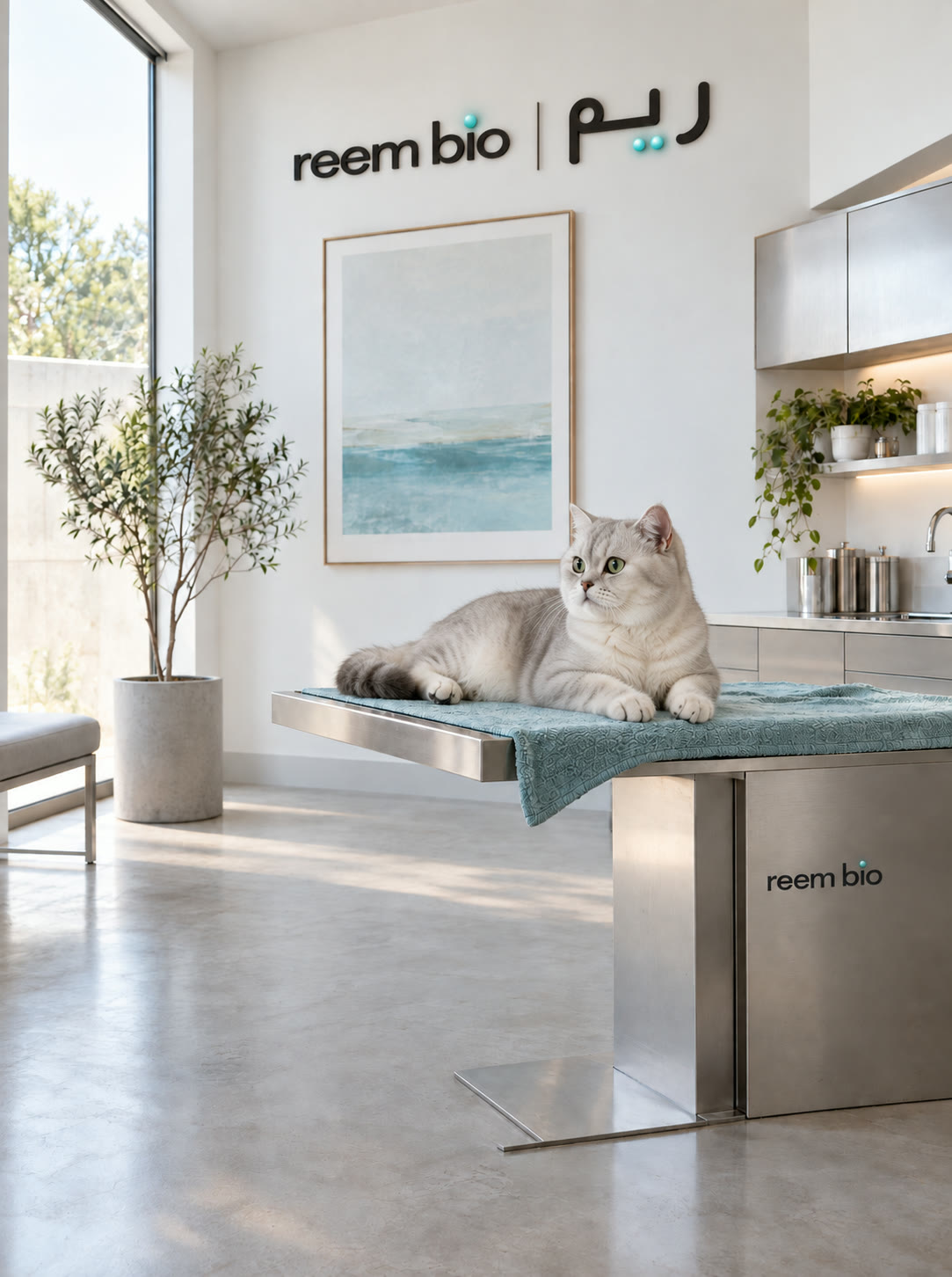
Cats cope well with the procedure. At a partner clinic it takes a few minutes in a quiet room, and most cats are home the same hour. For cats who dislike travel, a veterinarian can visit your home with a sealed collection kit.
ii.
What is possible, and what is not
The first cloned cat, born in 2002, was named CC – and she did not share her donor's calico markings. That single fact explains more about cloning than any brochure. Coat pattern in cats depends partly on which X chromosome is active in each skin cell, a process that happens by chance in the embryo. A genetic twin of a tortoiseshell or calico cat will almost certainly look different. Solid-coloured cats tend to look much more alike.¹
A cloned cat is…
- A genetic twin with the same nuclear DNA.
- A healthy kitten, born about 65 days after transfer.
- Verified by DNA before it comes home.
A cloned cat is not…
- Your cat, returned.
- Certain to share markings – especially calicos and tortoiseshells.
- Certain to share temperament.
Genetic testing is useful for pedigree cats in particular. Published markers exist for several inherited conditions in breeds such as Persians, Maine Coons and Ragdolls, and results can guide breeding and veterinary care. We report associations honestly; a result is not a diagnosis.
iii.
Timelines
Day 0
Biopsy
Clinic or home.
Day 21
Line banked
Mirrored in two cities.
Months 2–8
Nuclear transfer
Only if you choose.
Months 6–12
Birth
Gestation about 65 days.
Banking takes about three weeks. A cloning programme, if you choose one, usually takes six to twelve months to birth, with the kitten coming home at around ten to twelve weeks old. We give ranges, and we tell you when a stage does not go as hoped.
iv.
Breed notes
We see Persians, British Shorthairs, Maine Coons and Bengals most often, alongside many much-loved cats of no particular breed. For flat-faced breeds, collection at a clinic is preferred so any sedation can be managed carefully. Elderly cats with kidney disease can still be banked; your veterinarian will advise on timing.
If you keep a cattery, a banked line from a foundation cat can support future breeding decisions long after the cat itself has retired.
v.
Prices
- Cell banking, UAE
- $5,000
- Cell banking, GCC
- $6,500
- Cryostorage
- $500 a year, from the second year
- Genetic testing
- On request
- Cloning
- From $65,000, from a banked line
vi.
Questions
- Will a cloned cat have the same coat?
- Not necessarily. Patterned coats – calico and tortoiseshell above all – are partly set by chance in the embryo and will usually differ. Solid colours are more alike.
- Is my cat too old to bank?
- Rarely. Older cats' cells grow more slowly, but we bank lines from cats in their late teens.
- Does my cat need to travel?
- No. A veterinarian can collect at home with a sealed kit.
- Can I bank after my cat has died?
- Often, if a sample is taken within a day and the body is kept cool, not frozen. See Urgent.
- How much does cloning a cat cost?
- From $65,000, from a banked line. Banking itself is $5,000 in the UAE.
- Do you test pedigree cats?
- Yes, for inherited conditions with published markers, and for parentage. Prices on request.
Begin with a conversation about your cat.
Book a consultation