Science
The method,shown in full.
Everything we offer rests on one ordinary laboratory skill: keeping cells alive. Here is how we do it, and the evidence behind it. Terms are defined in the glossary.
i.
Culture
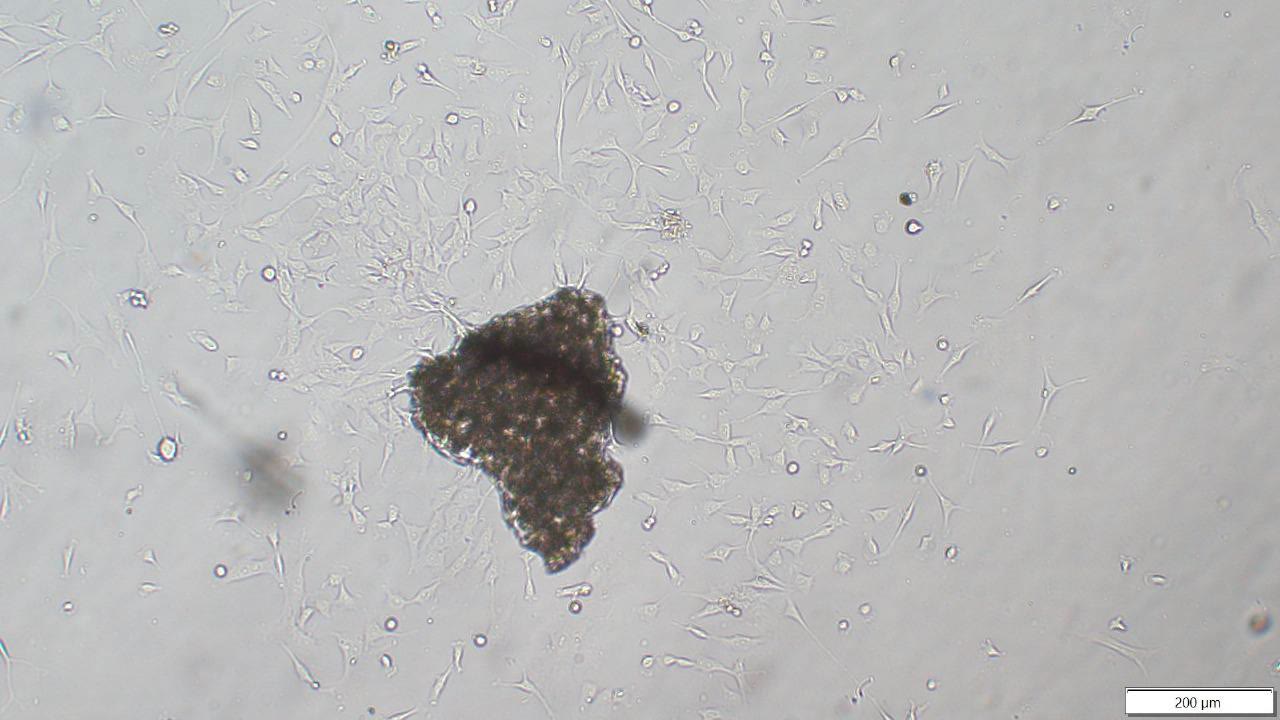
A biopsy is cut into fragments of about a millimetre and laid in a culture dish. Within days, fibroblasts migrate out of each fragment – the explant – and begin to divide. When they cover the dish they are lifted and spread into larger flasks. We stop at low passage, while the cells are young and their chromosomes stable.
ii.
The culture timeline
Day 0
Explant
Tissue fragments plated.
Day 3
Outgrowth
First fibroblasts appear.
Day 14
Confluence
Cells cover the flask.
Day 21
Banked
Tested, frozen, mirrored.
iii.
Cryopreservation
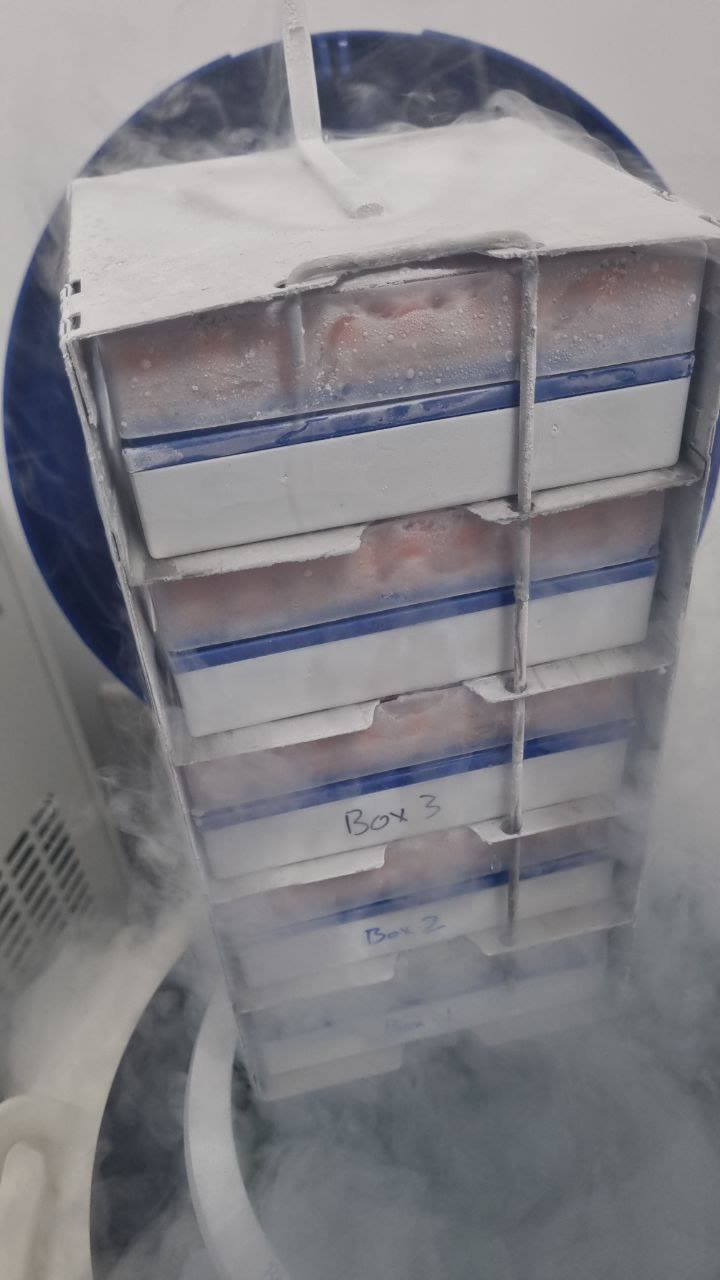
Cells are suspended in a protective medium, cooled at about one degree a minute, and moved to nitrogen vapour. Slow cooling lets water leave the cell before it can freeze into damaging crystals – a principle described in the 1970s and still the basis of cell banking today. One vial from every deposit is thawed and counted before the line is certified.¹
iv.
Nuclear transfer
v.
The literature we build on
Our own papers will be listed here as they are published. Until then, these are the studies our methods rest on – each one open to anyone who wants to check our reasoning.
- 1984
- Mazur – Freezing of living cells: mechanisms and implications. American Journal of Physiology.
- 1997
- Wilmut et al. – Viable offspring derived from fetal and adult mammalian cells. Nature.
- 2002
- Shin et al. – A cat cloned by nuclear transplantation. Nature.
- 2003
- Galli et al. – A cloned horse born to its dam twin. Nature.
- 2010
- Wani et al. – Production of the first cloned camel by somatic cell nuclear transfer. Biology of Reproduction.
vi.
Advisory board
Reproductive biology
- Reviews
- Nuclear transfer and surrogacy programmes
- Meets
- Quarterly
Veterinary medicine
- Reviews
- Animal welfare and collection protocols
- Meets
- Quarterly
Cryobiology
- Reviews
- Freezing, storage and thaw records
- Meets
- Twice a year
The board is independent of the laboratory: its members are not paid by results and can stop any programme on welfare grounds. Members are named here once their appointments are signed. The people at the bench are on the team page.
vii.
Standards
- Sterility
- Every line tested for bacteria and fungi before banking.
- Mycoplasma
- Every line screened by PCR before banking.
- Identity
- A DNA profile recorded for every line and checked at every later use.
- Chain of custody
- Barcoded vials, logged at every movement from biopsy to vault.
- Welfare
- Veterinary oversight of every animal involved, including surrogates.
Notes and sources
- ¹Mazur P. Freezing of living cells: mechanisms and implications. American Journal of Physiology 247, C125–C142 (1984).
- ²Wilmut I. et al. Viable offspring derived from fetal and adult mammalian cells. Nature 385, 810–813 (1997).
- ³Galli C. et al. A cloned horse born to its dam twin. Nature 424, 635 (2003).
- ⁴Shin T. et al. A cat cloned by nuclear transplantation. Nature 415, 859 (2002).
- ⁵Wani N.A. et al. Production of the first cloned camel by somatic cell nuclear transfer. Biology of Reproduction 82, 373–379 (2010).