Cloning is a genetic twin,not a return.
We use the phrase genetic twin on purpose. This essay explains why – what cloning shares between two animals, what it does not, and why it matters to say so before anything else.
Reem Bio Laboratory ·
i.
Twins, born apart
Identical twins are the most familiar example of two individuals who share the same DNA. They begin as a single embryo that divides in two, and they are born on the same day. Nobody confuses them for one person. They have different fingerprints, different friends, often different temperaments. Those who know them well can tell them apart at a glance. Their shared genome is the starting point of two lives, not a guarantee of one.
A cloned animal is, in genetic terms, very like an identical twin of its donor – with one great difference. It is born years later, to a different mother, into a different world. Everything that shapes a life other than the genome is new: the womb it grows in, the home it is raised in, the people who care for it, the chance events of its own development. For this reason we call the result a genetic twin. The phrase is accurate, and it is kind.
ii.
How cloning works
The method is somatic cell nuclear transfer. An egg is taken from a female of the same species, and its nucleus – the part of the cell that holds the DNA – is removed with a fine glass pipette under a microscope. A cell from the donor animal, usually a fibroblast grown from a banked line, is then placed against the empty egg and the two are fused. The egg now carries the donor's genome. With a gentle stimulus it begins to divide as though it had been fertilised. After several days in culture, the embryo is transferred to a surrogate mother, who carries the pregnancy to term.¹
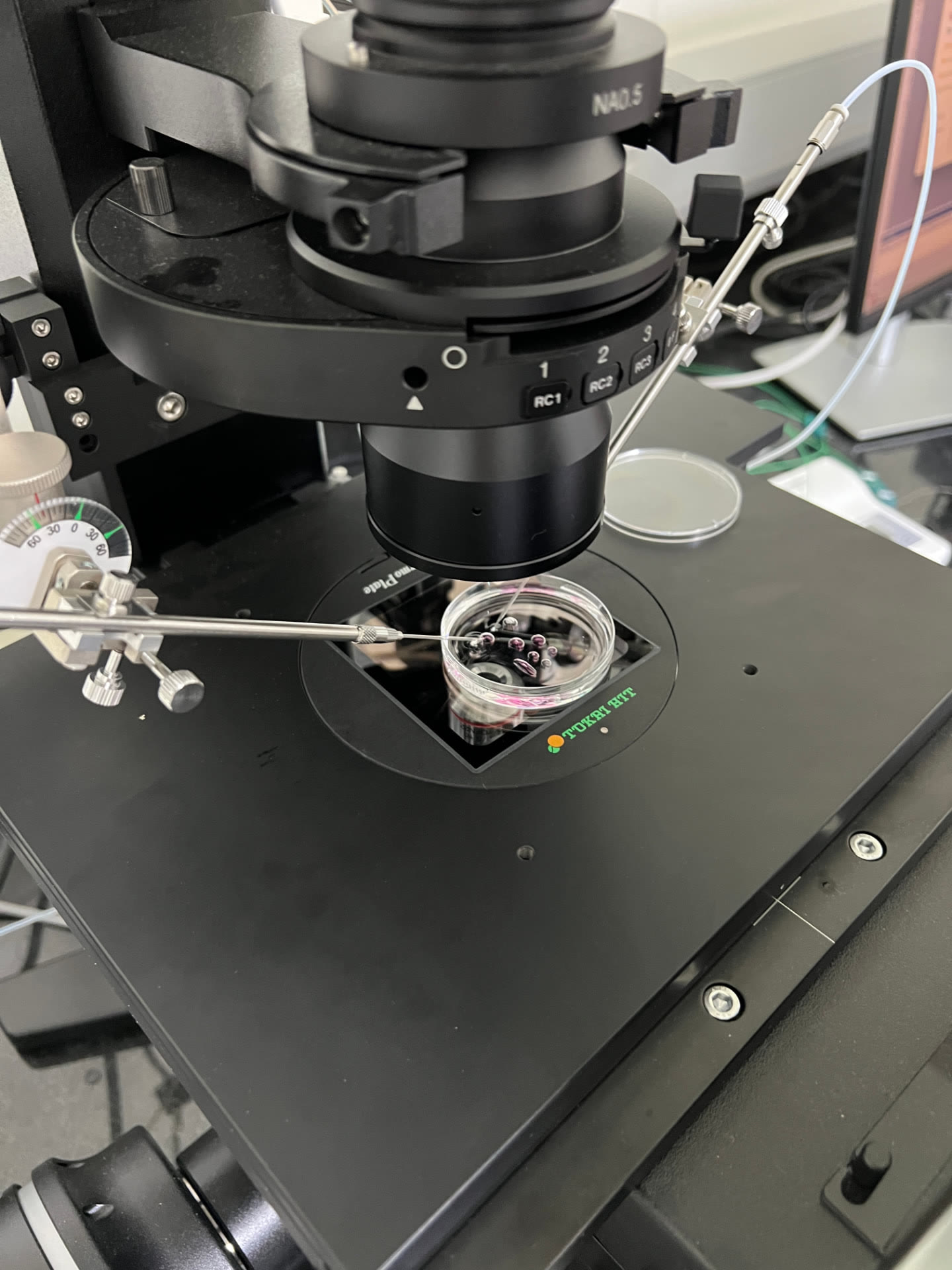
The first mammal cloned from an adult cell was Dolly the sheep, born in Scotland in 1996 and announced in 1997. Cats followed in 2001, dogs in 2005, and camels in 2009. The method is now routine in several species, though its efficiency remains modest: many embryos are needed for each birth, which is why we describe timelines as ranges.
iv.
What differs
Memory is not stored in DNA. A genetic twin will not recognise its donor's home, its family or its name. It will learn them, if it is raised there, as any young animal would. Training, habits and the particular ways an animal responds to the people it knows are the product of a life, and a life is not copied.
Appearance can differ too. The first cloned cat, CC, was born in 2001 to a calico donor – and was not calico. Her coat was tabby and white. In cats, the pattern of orange and black patches depends on which of two X chromosomes happens to be active in each patch of skin, a choice made by chance in the embryo. The same principle, in subtler forms, affects markings in other species. Chemical marks on the DNA that influence how genes are used – the field known as epigenetics – are partly reset during cloning, and develop anew in the twin.²
Character sits in between. Temperament has a genetic component, and genetic twins are often alike in energy or disposition. But character is also shaped by upbringing, experience and chance. An owner who hopes for a particular personality should be prepared to meet a new one.
A genetic twin is…
- A new animal with its donor's nuclear DNA.
- Usually very similar in breed, build and colouring.
- Its own individual, with its own life.
A genetic twin is not…
- A return of the animal that died.
- A copy of memory, training or character.
- Certain to look identical.
v.
Why we say this first
Many people who come to us about cloning have just lost an animal, or fear they soon will. Grief makes hope very strong. It would be easy, and wrong, to let that hope run ahead of the science. So we state the limits before the promise, every time: a genetic twin shares DNA, not memories; coat and character may differ; we cannot guarantee an outcome, a timeline or a likeness. We tell owners when a pregnancy is not progressing. We never use words that suggest an animal can be brought back.
This honesty is not a disclaimer. It is what makes a good decision possible. Owners who choose cloning with a clear understanding of what it offers tend to welcome the new animal for itself. And many owners, having understood it, decide that preservation alone is enough – that knowing the line is safe in two cities is what they wanted. Both are good outcomes. What we want to avoid is a decision made on a misunderstanding.
The practical details – stages, timelines, prices and surrogate welfare – are set out on Continue. The first step, in every case, is preservation.
- Will a clone remember anything?
- No. A genetic twin shares DNA, not memories or experience. It is its own individual from birth.
- Will it look identical?
- Often similar, not always identical. Coat patterns, especially in cats, are shaped during development and can differ.
- How long does it take?
- Timelines are ranges. For dogs and cats, typically six to twelve months from an established line; for camels, longer because gestation is about thirteen months.
- Can you guarantee a birth?
- No. Not every transfer leads to pregnancy. We tell you at every stage what has happened.
Talk it through before you decide.
Book a consultation