Why we storeevery line in two cities.
A vault is only as reliable as its single points of failure. We remove one of the largest by keeping half of every deposit somewhere else entirely.
Reem Bio Laboratory ·
i.
One building is not enough
Cell banking asks an owner to trust a physical place with something that cannot be recreated if it is lost. A dewar of liquid nitrogen is a stable, well-understood piece of equipment, and modern facilities monitor temperature continuously and refill nitrogen on a strict schedule. But it is still one building, subject to the same risks as any building: mechanical failure, a supply chain interruption, a fire, flooding, or simply an administrative error during a facility move. No amount of care inside a single site removes the fact that it is a single site.
This is not a hypothetical concern specific to us. It is the same reasoning that leads seed banks to hold duplicate collections on different continents, and that leads data centres to replicate records across regions rather than trust one server room. Biological material that cannot be regrown from a blueprint deserves at least the same discipline.
ii.
How a deposit is split
Every deposit banked with Reem Bio produces twelve vials from the same expanded culture, tested together for viability, identity and contamination before any of them leave the laboratory that grew them. Six vials remain in the primary vault, typically our Abu Dhabi headquarters. The other six travel to a mirrored vault, typically our Bahrain laboratory, at the same storage temperature of −196 °C. As our California laboratory and the coming Doha and Riyadh sites come fully online, mirroring will extend across that wider network, giving an owner more choice over where their second copy sits.
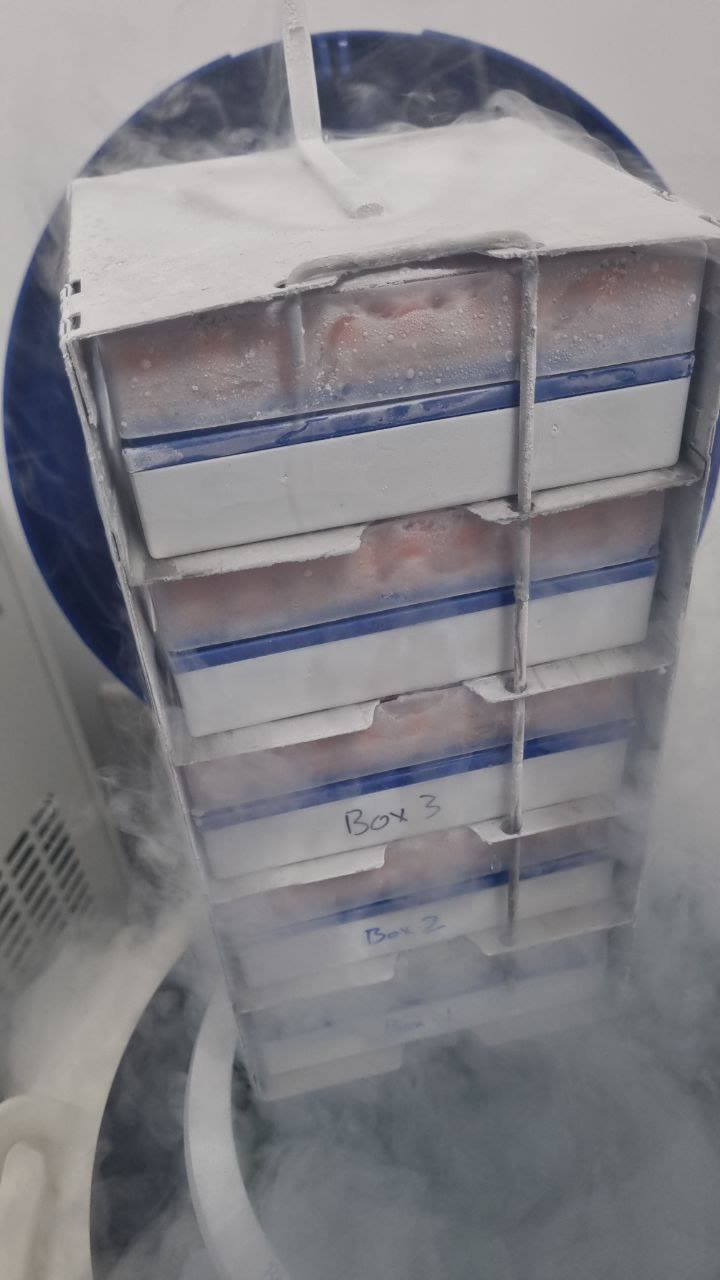
The transport itself is the part most owners never see, and it is deliberately unremarkable: a validated dry shipper, which holds nitrogen vapour rather than liquid and can maintain deep cryogenic temperature for days without external power, carries the vials by the fastest reasonable route between our laboratories. This shipping is included in the cell banking fee; it is not a separate line item an owner has to negotiate later.
iii.
What this protects against, and what it does not
Mirroring protects against loss of the entire line to a single event at one facility. It does not protect against a flaw that existed before the split – a contaminated culture, a mislabelled sample, a biopsy that was already too degraded when it arrived, as discussed in the first 72 hours. That is why testing happens before the vials are divided, not after: identity profiling, viability counts, and screening for mycoplasma and other contamination are run on the whole batch, so that both halves of a deposit start from the same verified baseline.
What is duplicated, and where
- Cell vials
- Six of twelve held at the primary site, six at the mirror site
- Identity record
- DNA profile and chain-of-custody documentation held at both sites and centrally
- Storage temperature
- −196 °C maintained independently at each site with continuous monitoring
- Growth and test records
- Passage history, viability results and contamination screens duplicated with the vials
iv.
The cost of doing this
There is also a quieter benefit in how mirroring changes the incentives inside the laboratory itself. Once a deposit is split, no single technician, no single freezer, and no single day's work is solely responsible for whether a line survives. Processes have to be documented well enough that a colleague at another site, who never met the animal or handled the original biopsy, can confirm exactly what is in a given vial and how it has been maintained. That discipline, imposed by the structure itself rather than by any individual's memory, tends to improve record-keeping across the board, not only for the vials that happen to be shipped.
Mirroring does not add a separate charge on top of the standard fees. Cell banking is 5,000 USD for clients within the UAE and 6,500 USD across the wider GCC; cryostorage after that is 500 USD per year, covering both halves of the deposit and their independent monitoring. Shipping between our laboratories, whether for the original mirroring or for a later transfer requested for genetic testing, is included rather than billed separately. We built the pricing this way because we did not want owners choosing against redundancy to save money; it is a full account of pricing without hidden additions, in keeping with the approach set out in prices in full.
There is a practical benefit beyond risk reduction, too. If a client relocates – a family moving from Abu Dhabi toward a future Doha or Riyadh presence, for instance – having material already banked in more than one location can simplify a later transfer, a subject covered on its own in moving countries. Redundancy, in other words, is not only about disaster; it is also about flexibility over a period that may span decades.
v.
Why we describe this openly
We explain the mirroring structure in some detail because we think vagueness is the wrong instinct for something this consequential. A family committing a biopsy from an animal that has died, or arranging a biopsy from one that is aging, deserves to know exactly where the resulting vials will sit, how they are labelled, and what happens if one facility has a bad month. Our approach to that broader question of transparency is set out further under trust; the specific documentation issued for every deposit is described in what a vault certificate certifies.
None of this changes what preservation can promise. Two cities reduce the chance that a line is lost to a single event; they do not change what happens biologically when cells are frozen, nor do they guarantee any particular outcome from later use of the material, whether for testing, for stem cells or PRP, or for cloning. What they add is ordinary operational caution, applied consistently, to something that cannot be replaced if it is mishandled.
- Where are the two copies of my animal's cells stored?
- Typically one set of six vials in our Abu Dhabi headquarters and a mirrored set of six in our Bahrain laboratory, both maintained at −196 °C. As our California, Doha and Riyadh sites expand, clients will have more choice over the mirror location.
- Does splitting the deposit cost extra?
- No. The standard cell banking fee of 5,000 USD (UAE) or 6,500 USD (GCC), plus 500 USD a year in cryostorage, covers both halves of the deposit, including the shipping required to establish the mirror.
- What happens if one facility has a problem?
- The other site retains a full, independently maintained set of vials sufficient to rebuild the line. Mirroring exists specifically to make a single-site event survivable.
- Does mirroring fix a poor-quality sample?
- No. Splitting happens only after a deposit passes viability, identity, and contamination testing. A sample that fails those tests is not banked, mirrored or otherwise.
Ask how your line would be stored.
Book a consultation