Fibroblasts: the cellwe culture, and why.
Preservation depends on choosing the right cell for the job. For almost every species we work with, that cell is the fibroblast, and its ordinariness is exactly the point.
Reem Bio Laboratory ·
i.
An unglamorous, reliable cell
Fibroblasts are the cells that build and maintain connective tissue – the scaffolding of collagen and other structural proteins that holds skin, tendons and much of the body together. They are not specialised in any dramatic sense; they do not conduct electricity like a neuron or contract like a muscle cell. What they do is produce structural material, migrate toward damage, and divide readily when given the right conditions. That last property, more than any other, is why they are the cell of choice for preservation.
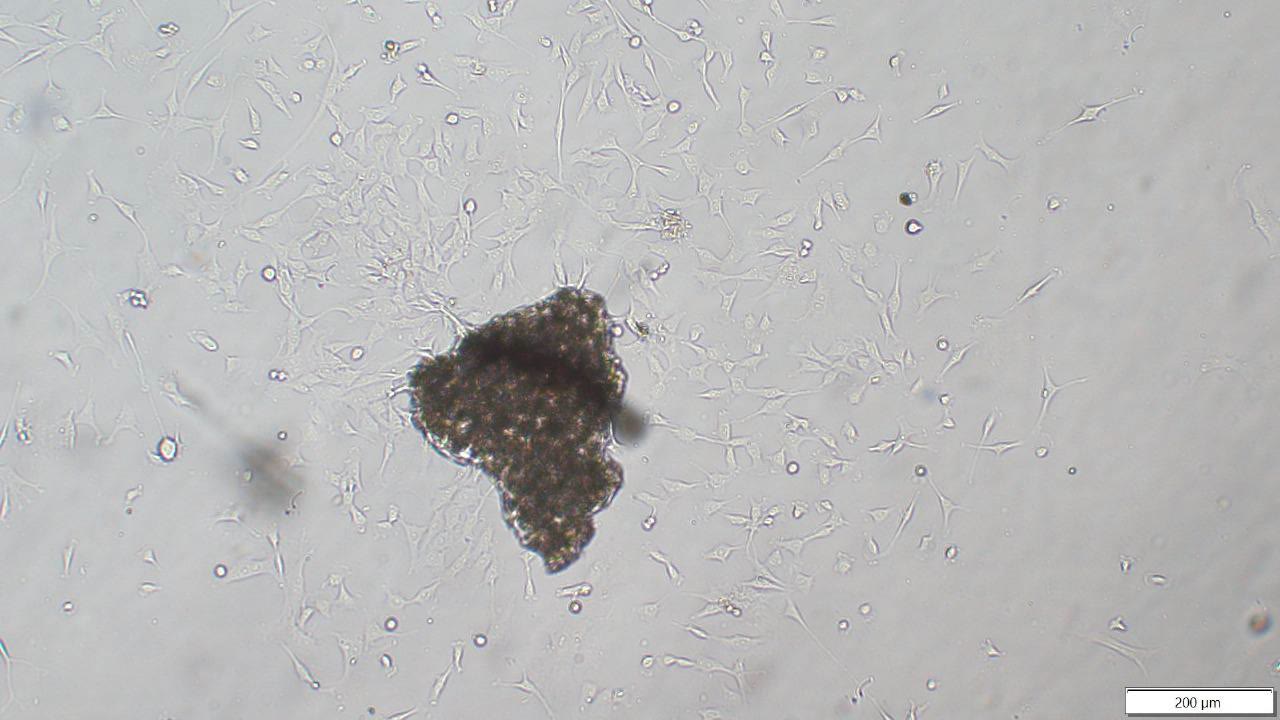
A skin biopsy a few millimetres across contains many cell types, but fibroblasts are consistently the ones that leave the tissue fragment first and establish a growing culture on a plastic dish. Within a day or two of an explant being placed in a nutrient medium, fibroblasts can be seen migrating outward, spindle-shaped and easy to recognise under a microscope. Other cell types present in the same biopsy tend to grow more slowly or not at all under standard conditions, so within a couple of passages a culture that started as a mixed tissue fragment becomes, in practice, a fibroblast line.
ii.
Why skin, and why this cell
Skin is chosen for the biopsy itself because it is accessible with a minor procedure, heals quickly, and yields fibroblasts reliably across the species we work with – cats, dogs, camels, horses, and others. A punch biopsy from the ear or flank is a small, well-tolerated procedure for a veterinarian to perform, whether the animal is alive under local anaesthetic or the sample is taken shortly after death, as described in the first 72 hours.
Fibroblasts also happen to be a forgiving cell to culture and to freeze. They tolerate the standard cryoprotectants used in banking well, survive a controlled slow freeze at a high rate, and, after thawing, resume dividing without extensive coaxing. None of this is unique to fibroblasts among all cell types, but relative to alternatives – blood cells, which mostly do not divide once mature, or tissue-specific cells that require far more complex conditions to grow outside the body – fibroblasts offer the most practical combination of ease of collection, ease of growth, and reliability in storage.
iii.
One cell, the whole genome
It is worth stating plainly why a fibroblast is enough, even though it is, in the body, just one modest cell type among many. Almost every cell in an animal carries a complete copy of its genome, regardless of which genes are actively in use. A fibroblast uses only the small subset of genes needed to build collagen and maintain structural tissue, but the rest of the genome sits in its nucleus intact, unused but present. This is the same fact that makes genetic testing possible from a banked vial years later, and it is the same fact that makes the nucleus of a fibroblast usable as the genetic source for cloning.¹
This is also why we describe fibroblasts as a means rather than an end. The cell itself does very little that anyone would call remarkable. What it carries – and can be induced to give up on demand, through DNA extraction or through somatic cell nuclear transfer – is what makes the culture worth keeping.
iv.
What fibroblasts cannot do on their own
It is worth noting, too, that fibroblasts are not unique to mammals in the way this article has mostly discussed. Reptiles and birds also have fibroblast-like connective tissue cells that can, in principle, be cultured using similar methods. Where our laboratories currently offer preservation for birds, it stops at banking the line itself rather than extending to cloning, reflecting differences in reproductive biology and in the surrogate and donor-egg processes that mammalian cloning depends on, rather than any limitation in the fibroblasts themselves.
A frozen fibroblast is not, by itself, a stem cell, and it is not a treatment. If a veterinarian prescribes stem cells or PRP for an animal, the cells used are typically derived separately, often reprogrammed or isolated from different tissue depending on the protocol involved, and that work sits outside the scope of a standard banked fibroblast line unless specifically arranged. We are careful about this distinction because the word cell covers a wide range of possibilities, and a client who has banked a fibroblast line should not assume it converts automatically into a regenerative therapy without further laboratory work, a veterinary prescription, and case-by-case evaluation.
Similarly, a fibroblast line does not, on its own, produce a clone. It provides the nucleus; a separate and substantial process involving a donor egg and a surrogate animal is required to attempt to grow that nucleus into a new animal, a process outlined in cloning is a genetic twin. Preservation and cloning are related but distinct services, priced and undertaken separately, which is one reason cloning at Reem Bio starts from 65,000 USD for cats, 85,000 USD for dogs, and 100,000 USD for camels, with horses handled by individual consultation.
What a fibroblast line is, and is not
A banked fibroblast line is…
- A complete, unused copy of the animal's genome, kept alive
- A source for DNA extraction and genetic testing on request
- The genetic starting point for a possible future cloning attempt
A banked fibroblast line is not…
- A stem cell or regenerative treatment by itself
- A guarantee of any particular outcome from later use
- A substitute for a veterinarian's evaluation and prescription
v.
What happens to the line once banked
Once a fibroblast culture reaches confluence at low passage, cells are counted, mixed with a cryoprotectant, and cooled gradually before storage at −196 °C. Twelve vials are produced from a standard deposit, split between our primary laboratory and a mirrored vault in a second city, as set out in two cities. Growth, viability and identity data collected during this process form the growth record issued with the final certificate.
From that point, the line sits at storage temperature, at 500 USD per year in cryostorage, until an owner decides to do something with it, or decides not to. Birds are the one group where our laboratories currently stop at preservation itself, without downstream cloning, given the different biology and additional constraints involved; that limit is described in falcons and the limits of cloning.
- Why do you culture fibroblasts rather than another cell type?
- Fibroblasts are the cells that reliably migrate out of a skin biopsy, grow well in standard culture, and survive freezing and thawing with high viability, making them the most practical cell for long-term genetic preservation across species.
- Is a banked fibroblast line the same as a stem cell treatment?
- No. Fibroblasts are a source of preserved genetic material, not a regenerative therapy. Stem cell or PRP treatments involve separate cells and a veterinarian's prescription, with outcomes that vary by case.
- Can a fibroblast line be used for cloning by itself?
- The nucleus from a fibroblast provides the genetic material, but cloning also requires a donor egg and a surrogate animal, and is a separate, specifically priced process undertaken on request.
- What happens to a fibroblast line if I never use it?
- It remains in cryostorage at −196 °C, split across two of our laboratories, for as long as the annual storage fee is maintained. Many lines are never thawed, and that is a normal outcome.
Ask what a fibroblast line would mean for your animal.
Book a consultation